 listicle
Bespoke Bhutan Itinerary: 7 Days of Luxury
Table of Contents
- Why a Bespoke Bhutan Itinerary Beats a Standard 7-Day Tour
- Bhutan Sustainable Development Fee 2025: What It Costs and What It Covers
- Bhutan Travel Logistics and Planning: Visas, Permits, and Private Transport
- Day-by-Day: A Sample 7-Day Bespoke Bhutan Itinerary
- Luxury Boutique Hotels in Bhutan: Where to Stay on a Bespoke Trip
- Solo vs Group Travel: Customising Your 7-Day Itinerary
- Photography Tips for High-Altitude Bhutan and Off-the-Beaten-Path Experiences
- Frequently Asked Questions
Last Updated: September 16, 2026
Why a Bespoke Bhutan Itinerary Beats a Standard 7-Day Tour
The difference between a packaged tour and a bespoke Bhutan itinerary 7 days in the making comes down to one thing: who decides what your day looks like. On a fixed departure, the answer is the brochure. On a private itinerary, it is you.
This guide from Iconic Bhutan Travels A Pristine Journey is for travellers who want the Himalayan kingdom on their own terms, people who would rather spend an extra hour at Punakha Dzong than tick off a sixth monastery before lunch.
Standard group tours follow the same circuit: Paro, Thimphu, Punakha, Tiger's Nest, home, identical to what every other visitor sees that week.
A bespoke itinerary changes the sequencing, the pace, and the access. Add Phobjikha Valley when the cranes are in residence, swap a museum for a farmhouse lunch, or build in a rest morning at altitude. That flexibility is the entire product.
The 7-day framework below is a starting point we reshape around your interests, your fitness, and how much driving you want to do.
Bhutan Sustainable Development Fee 2025: What It Costs and What It Covers
The Sustainable Development Fee (SDF) is a daily levy every visitor pays, charged per person, per night of stay, and separate from your tour costs, accommodation and flights. It is the single line item that most changes what a week in the kingdom costs.
For most adult visitors the standard rate is USD 100 per person, per night. Children aged between six and twelve typically pay a reduced rate of USD 50 per night, and children under six are generally exempt. These figures are set by government policy and are revised from time to time, so confirm the current rate with the Department of Immigration, Bhutan or your operator before you finalise a budget.
What matters for planning is the mechanism. The SDF is not a tax you can avoid by booking a cheaper hotel or travelling in low season, it is a condition of entry, collected as part of your visa and tour arrangement. For a seven-night stay, that is seven nights of SDF per person, on top of guiding, transport, lodging and meals.
Where the money goes is the part most guides skip. The fee funds free healthcare and education, maintains forest cover, constitutionally required to stay above 60 per cent of land area, and conserves heritage sites such as the Dzongs and monasteries on your route. In practical terms, it keeps visitor numbers low enough that a morning at Punakha Dzong is not a queue.
Budget for it as a fixed line item, not a variable, then build the rest of your plan around it. Frame the trade as cost per experience rather than cost per day: the fee is high, but it buys uncrowded access to sites that would otherwise be overrun.
Operators commonly quote the SDF separately from land cost so travellers can see what is government levy and what is service. Ask for that split in writing, it makes comparing two bespoke proposals far easier and stops the fee being absorbed into an opaque figure.
Bhutan Travel Logistics and Planning: Visas, Permits, and Private Transport
Bhutan travel logistics and planning come down to three moving parts: visa processing, route permits, and a private vehicle with a licensed guide. Independent travel is not permitted, so every visitor arrives on a package through a certified operator.
Start with the visa. Applications are submitted online and processed through the Department of Immigration, Bhutan, typically with your operator handling the submission and the SDF payment on your behalf. You will need a passport valid for at least six months, a passport photo, and confirmed travel dates.
Permits come next. Certain districts and monasteries require a route permit, arranged by your guide as part of the itinerary, one of the quieter advantages of a bespoke plan: the paperwork follows the route, not the other way around.
Transport is the third piece.
- Visa: online application, operator-assisted, allow several weeks
- SDF: paid per night, arranged with your booking
- Permits: district-specific, handled by your guide
- Transport: private vehicle, licensed guide, flexible daily schedule
Day-by-Day: A Sample 7-Day Bespoke Bhutan Itinerary
A well-built 7-day route moves west to east and back, keeping altitude gain gradual and driving days reasonable. The sequence below is the spine we work from; the detail changes with the season and your interests. Each day includes a bespoke alternative, because the difference between a standard tour and a tailored one is usually what you do instead of the obvious stop.
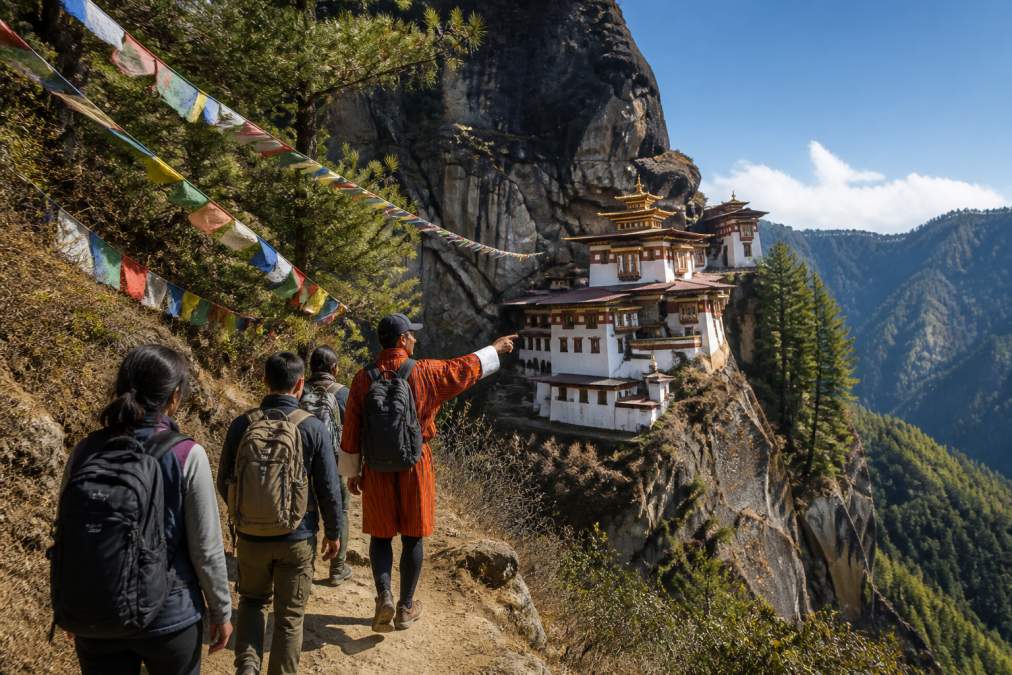
Days 1-2: Paro Valley and Tiger's Nest Monastery
Paro Valley is where most journeys begin, and acclimatization matters. Day one is deliberately light: Rinpung Dzong, the traditional architecture of the town, and an early night. Paro sits at roughly 2,200 metres, so resist doing too much on arrival.
Days 3-4: Thimphu and Dochula Pass
Thimphu is the capital and the only one without traffic lights, which tells you something about the pace. Highlights are compact: the Buddha Dordenma, the weekend market, and the textile and heritage museums. The drive from Paro is typically under an hour and a half, leaving most of the day free.
Days 5-6: Punakha Valley and Phobjikha Valley
Punakha Dzong sits at the confluence of two rivers and is, for many travellers, the most beautiful building in the country. The valley is lower and warmer, a welcome break from the cold, and the drive from Thimphu over Dochula Pass takes around three hours, depending on road conditions.
Day 7: Return to Paro and Departure
The final day is a transfer back to Paro with time for last-minute shopping or a short temple visit before your flight. Build in a buffer: mountain weather does not read itineraries, and the drive from Punakha can take four to five hours in poor conditions.
Luxury Boutique Hotels in Bhutan: Where to Stay on a Bespoke Trip
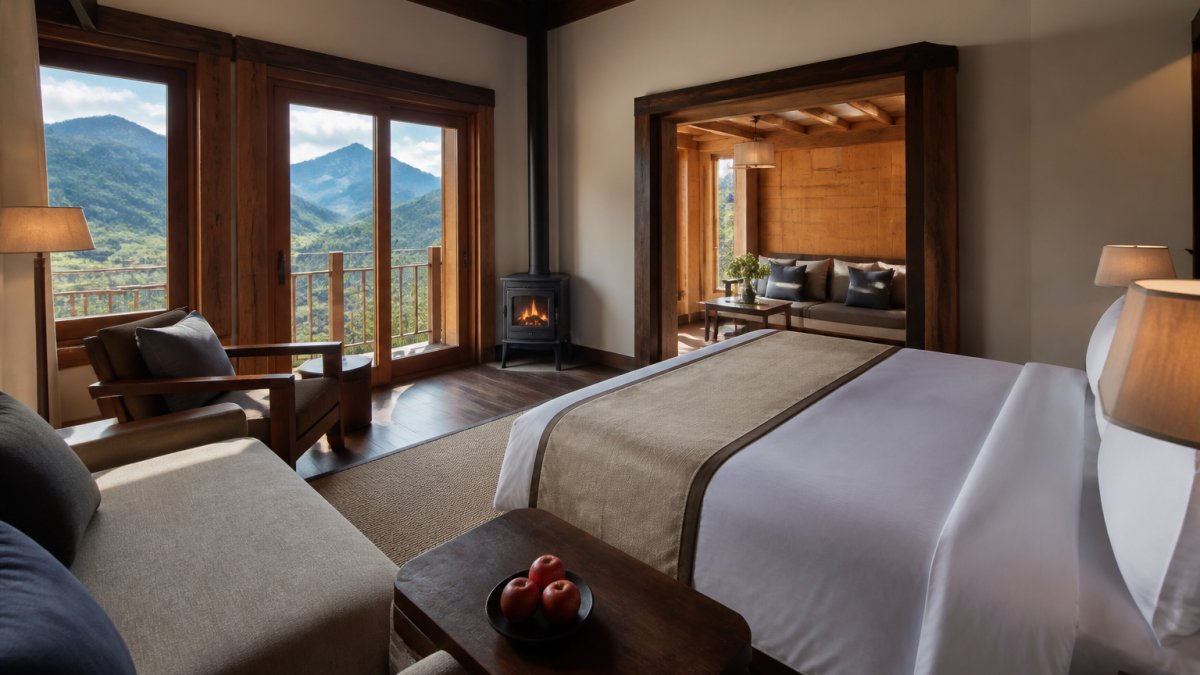
Luxury boutique hotels in Bhutan split into two families: international five-star properties and the smaller, design-led lodges most bespoke travellers end up preferring.
Solo vs Group Travel: Customising Your 7-Day Itinerary
If you are weighing solo against joining a group, decide on two questions. How much do you value unscheduled time, and how much do you mind compromising on the day's plan? A bespoke itinerary is the answer when the first number is high and the second is low.
Photography Tips for High-Altitude Bhutan and Off-the-Beaten-Path Experiences
High-altitude photography in Bhutan rewards preparation more than gear. The light is harsh at midday and the best subjects, Dzongs, monks, prayer flags, are often in deep shade against a bright sky.
Practical points that matter at altitude:
- Carry spare batteries and keep them warm; cold drains them fast
- Use a polarising filter to control glare on bright skies
- Bracket exposures for high-contrast monastery interiors
- Ask before photographing people, and accept a no
Frequently Asked Questions
What is a good itinerary for a 7-day trip to Bhutan?
A balanced 7-day bespoke Bhutan itinerary typically covers Paro, Thimphu, and Punakha. Start with acclimatisation in Paro and a hike to Tiger's Nest Monastery. Then explore Thimphu's cultural sites, cross Dochula Pass for Himalayan views, and continue to Punakha Dzong. Include a night in Phobjikha Valley for a deeper connection to nature and local life. Each day blends guided sightseeing with free time, and your operator adjusts pacing to your interests and energy levels.
How much does a 7-day trip to Bhutan cost?
The total cost depends on your choice of accommodation, group size, and season. The mandatory Sustainable Development Fee (SDF) is a fixed daily charge for all visitors, and it is included in most all-inclusive packages. Luxury boutique hotels, private guides, and transport add to the base. Because pricing varies, request a personalised quote from your operator. They will break down the SDF, hotel rates, meals, and activities so you see exactly what you are paying for.
Is 7 days enough to experience the highlights of Paro, Thimphu, and Punakha?
Yes, seven days gives you enough time to see the major highlights without feeling rushed. You can spend two nights in Paro, two in Thimphu, and two in Punakha, with a scenic drive over Dochula Pass connecting the valleys. This allows for a full day at Tiger's Nest, unhurried exploration of Punakha Dzong, and a visit to a local market. A bespoke itinerary can also add a night in Phobjikha Valley if you prefer a slower pace.
How does a bespoke itinerary differ from a standard group tour in Bhutan?
A bespoke itinerary is built around your interests, pace, and preferred level of comfort. Instead of fixed departure dates and shared vehicles, you travel privately with a guide and driver. You can choose luxury boutique hotels, add off-the-beaten-path experiences like farmhouse meals or meditation sessions, and adjust daily activities on the spot. Standard group tours follow a set schedule, while a bespoke trip gives you flexibility and personal attention from a dedicated local team.
What luxury accommodation options are available for a bespoke Bhutan itinerary?
Bhutan has a growing collection of luxury boutique hotels and international brands, particularly in Paro, Thimphu, and Punakha. These properties blend traditional Bhutanese architecture with modern amenities such as spa facilities, fine dining, and valley views. Some are set in remote locations, offering privacy and direct access to nature. Your operator can match you with hotels that suit your style, whether you prefer a heritage farmhouse stay or a full-service resort with butler service.