 listicle
Bhutan Spiritual Retreats for Professionals: A 2026 Guide
Table of Contents
- Why Bhutan Spiritual Retreats Suit High-Pressure Professionals
- Luxury Wellness Retreats in Bhutan: What Sets the Top Tier Apart
- Guided Meditation, Yoga and Traditional Healing Practices
- Monastery Stay Etiquette in Bhutan: What Professionals Should Know
- The Best Time to Visit Bhutan for Spiritual Growth
- Planning Logistics and Costs for Solo Professional Travellers
- Conclusion: Choosing the Right Retreat for Your Career Stage
- Frequently Asked Questions
Last Updated: September 25, 2026
Why Bhutan Spiritual Retreats Suit High-Pressure Professionals
Bhutan spiritual retreats for professionals are structured wellness journeys that combine guided meditation, yoga asana and traditional healing with cultural immersion in a Buddhist kingdom. They work because they remove the two things that keep burnout cycles running: constant connectivity and constant decision-making.
Burnout rarely comes from one hard quarter.
Burnout Recovery in a Setting Built for Reflection
Recovery frameworks used in clinical settings usually involve three phases: decompression, active restoration and reintegration. A well-designed retreat mirrors that structure without you having to manage it.
Luxury Wellness Retreats in Bhutan: What Sets the Top Tier Apart
The top tier of luxury wellness retreats in Bhutan is defined by three things: private guiding rather than group touring, integrated wellness programmes rather than add-on spa treatments, and access to sites and teachers that independent travellers cannot arrange.
Below is how the leading properties and packages differ.
| Retreat | Format | Standout Strength | Best For |
|---|---|---|---|
| Iconic Bhutan Travels A Pristine Journey | Tailor-made, any duration | Fully custom itineraries with authentic cultural depth | Professionals wanting a bespoke trip built around their schedule |
| Six Senses Bhutan | Five-valley circuit | Multi-location wellness integration | Executives wanting a longer, multi-stop journey |
| Amankora | Lodge circuit | Privacy and exclusive sacred site access | Travellers prioritising seclusion |
| COMO Uma Paro & Punakha | Two-property retreat | Structured wellness programmes | Those wanting a defined, programme-led approach |
| Eat Pray Move | Fixed 7-day package | All-inclusive wellness and culture | Professionals who prefer a set itinerary |
Six Senses, Amankora and COMO: How the Leading Properties Differ
Six Senses spreads its offering across five valleys, so the journey itself becomes the programme. That suits executives who want variety but adds travel time between stops.
Guided Meditation, Yoga and Traditional Healing Practices
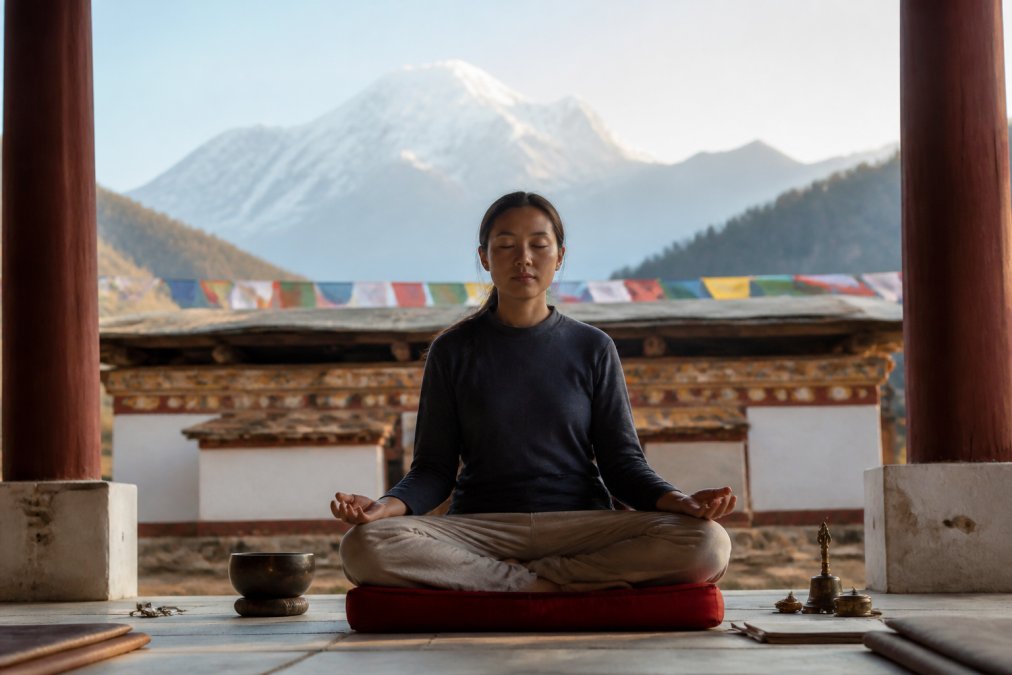
Expect a mix of guided meditation, yoga asana and traditional Bhutanese medicine, often delivered by local teachers and practitioners rather than visiting instructors. Sessions are typically gentle and accessible to beginners, and the emphasis is on consistency rather than intensity.
What a Typical Day of Practice Looks Like
Most retreats follow a loose rhythm rather than a rigid timetable:
- Early morning: guided sitting meditation, often 30 to 45 minutes, sometimes in a shrine room or monastery courtyard.
- Mid-morning: yoga asana, usually hatha or a gentle vinyasa style, adapted for altitude and for bodies that spend most of the year at a desk.
- Afternoon: breathwork, contemplative walking, or a teaching session with a monk or local practitioner.
- Evening: shorter guided meditation or a reflection session, followed by an early night.
Traditional Bhutanese Medicine and Holistic Healing
Traditional medicine in Bhutan draws on herbal treatments and holistic healing practices developed over centuries, and it is integrated into the national health system rather than treated as an alternative. Retreats typically pair it with breathwork and contemplative practice in three ways:
- Consultation: a practitioner takes a pulse and history, then recommends herbal preparations or dietary adjustments.
- Therapeutic treatments: hot stone baths, herbal compresses and oil treatments, often using locally sourced plants.
- Lifestyle guidance: advice on sleep, diet and daily rhythm that carries over after the trip.
Yoga at Altitude: What to Expect
Most retreat valleys sit between roughly 1,200 and 2,800 metres, and the altitude changes how yoga feels. Expect shorter holds, more rest between sequences, and a stronger focus on breath. Teachers will usually check in on how you are adjusting before progressing to more demanding sequences. If you are coming from a sea-level city and have not trained at altitude before, tell your teacher on day one.
Monastery Stay Etiquette in Bhutan: What Professionals Should Know
Monks are generally welcoming to respectful visitors who show genuine interest. Ask questions, accept offered tea, and let your guide handle introductions.
The Best Time to Visit Bhutan for Spiritual Growth
The best time to visit Bhutan for spiritual growth is spring, from March to May, or autumn, from September to November. Both windows offer clear skies, comfortable temperatures and the full festival calendar.
Planning Logistics and Costs for Solo Professional Travellers
Solo travel to Bhutan is straightforward once you understand two things: you must book through a licensed local operator, and you must pay the Sustainable Development Fee (SDF) for every night you stay. Independent travel is not permitted, so the operator requirement is not optional.
Budget Versus Luxury: What Actually Changes
Most of the price difference between tiers comes down to four variables, not the retreat programme itself:
- Accommodation: budget tiers use simple guesthouses and family-run lodges; mid-tier uses three and four-star properties; luxury uses internationally branded lodges and heritage properties.
- Guide ratio: budget and mid-tier typically join small groups; luxury tiers provide a private guide and vehicle for the full itinerary.
- Access: private audiences with monks, off-hours shrine visits and specialist teachers are generally only arranged at the luxury tier.
- Pace: budget itineraries run to a fixed schedule; luxury itineraries flex around how you actually feel on the day.
A Solo Professional's Pre-Departure Checklist
- Confirm your operator is licensed and can arrange your visa and SDF payment
- Ask what the SDF adds to your total, in writing, before you pay a deposit
- Choose a duration that matches your leave, five to seven days is workable
- Decide your connectivity policy before you arrive (see below)
- Arrange a buffer day at home before returning to work
- Tell your operator if you are travelling solo and want single-occupancy pricing confirmed
Digital Detox and Connectivity Management
This is the part most guides skip, and it is the part that determines whether the trip actually resets you. Many Bhutanese properties now offer reliable wi-fi, which makes a genuine detox harder than expected. Decide deliberately:
- Full detox: ask your operator for accommodation and activities in valleys with limited mobile signal, and hand your phone to your guide at the start of the retreat.
- Partial detox: keep your phone but disable work email and messaging apps, and set a single 20-minute window per day for anything urgent.
- Work-aware: if you genuinely cannot disconnect, schedule calls into a fixed afternoon slot so they do not fragment the rest of the day.
Re-Entry: Protecting the Reset After You Land
The reintegration phase is where most professionals lose the benefit of the trip. A common pattern is a strong first week back followed by a rapid return to old habits. Three practices that practitioners and returning travellers report as useful:
- Book a light first week. Do not schedule back-to-back meetings for the first three working days.
- Keep one daily practice. Even ten minutes of the meditation or breathwork you learned on retreat preserves the thread.
- Write a one-page re-entry note before you fly home: three things you will keep, three you will drop, and one boundary you will hold for the first month.
Conclusion: Choosing the Right Retreat for Your Career Stage
Early-career professionals usually get the most from structured programmes with set dates and clear frameworks. Senior executives tend to need flexibility more than structure, because their calendars will not bend around a fixed departure.
Frequently Asked Questions
What makes Bhutan spiritual retreats ideal for busy professionals?
Bhutan spiritual retreats combine structured mindfulness practice with genuine cultural immersion, which appeals to professionals who want more than a standard wellness holiday. The country's Buddhist philosophy and Gross National Happiness framework create an environment where stress reduction and self-reflection happen naturally. Most retreats offer guided meditation, yoga asana and breathwork sessions that fit into a 5-7 day window, making them practical for executives with limited leave. The absence of mass tourism also means fewer distractions and a more contemplative pace.
Do I need prior meditation experience to join a Bhutanese retreat?
No. Most luxury wellness retreats in Bhutan are designed for beginners and experienced practitioners alike. Guided sessions typically start with basic breathwork and mindfulness techniques, and instructors adjust the pace based on the group. Properties like COMO Uma Paro offer structured programmes that build gradually over several days. If you have never meditated, a retreat is actually a good place to start because the setting removes the usual distractions that make home practice difficult.
How does the Sustainable Development Fee affect retreat planning?
The Sustainable Development Fee (SDF) is a daily levy that all international visitors must pay, and it is separate from your retreat package price. This fee funds conservation and community development projects across the country. When comparing retreat costs, factor the SDF into your total budget alongside accommodation, meals and guided activities. Most reputable operators handle the SDF payment as part of their booking process, so you do not need to arrange it independently. Confirm with your operator what is included before you commit.
Can Bhutan spiritual retreats be customised for short trips or corporate groups?
Yes. Several operators offer tailored itineraries for professionals who can only travel for 5-7 days, focusing on a single valley rather than trying to cover the whole country. Corporate groups can also book private retreats that combine mindfulness sessions with leadership workshops or strategy offsites. The key is to book well in advance and communicate your goals clearly, whether that is burnout recovery, team building or personal spiritual growth. Customisation typically costs more than a fixed package but gives you control over pace and content.