 how-to
How to Plan a Mindful Bhutan Trip: A Complete Guide
Table of Contents
- Understand Bhutan's Entry Requirements and the Sustainable Development Fee
- Choose the Right Season and Pace Your Itinerary
- Select Bhutan Luxury Wellness Retreats That Match Your Goals
- Master Cultural Etiquette for Bhutanese Temples and Monasteries
- Pack Essentials for Bhutanese Monastery Visits and Mindful Practices
- Plan Your Digital Detox and Manage Connectivity
- Prepare Psychologically for High-Altitude Mindfulness and Post-Trip Integration
- Frequently Asked Questions
Last Updated: September 20, 2026
Understand Bhutan's Entry Requirements and the Sustainable Development Fee
To plan mindful Bhutan trip successfully, you must navigate unique entry formalities. Every visitor must book through a licensed operator and pay the Sustainable Development Fee (SDF), a daily charge that funds conservation and community projects, a legal requirement that shapes your budget and timeline.
Your operator handles visa processing, permits, and all logistics, so you're never navigating bureaucracy alone.
Choose an operator that understands mindful travel, not just logistics. This partnership shapes whether your trip becomes a rushed itinerary or a genuine practice.
Choose the Right Season and Pace Your Itinerary
Seasonal choice affects both budget and mindful experience quality.
Spring (March-May) brings rhododendron blooms and clear skies but 30-40% higher SDF rates during peak weeks (mid-April to early May) and crowded monastery visits. Budget an extra AUD $200-400 for premium accommodation.
Autumn (September-November) offers the best balance for mindful travel: clear visibility, moderate temperatures (15-22°C), and fewer tourists. November remains affordable and peaceful, ideal for intensive programmes.
Summer (June-August) brings monsoon rain and reduced visibility but genuine solitude, quieter monasteries, and costs 20-30% below peak season. Suits experienced meditators seeking isolation.
Winter (December-February) is cold (5-10°C at altitude) and clear with plummeting tourist numbers. Suits serious practitioners; book 3-4 months ahead.
Pacing matters more than season when you plan mindful Bhutan trip.
Here's a realistic 10-day mindful itinerary structure:
Days 1-2: Arrival and settling. Rest, take a gentle walk, visit one monastery without rushing. Allow altitude adjustment and jet lag recovery.
Days 3-4: First deep practice location. Stay in one place. Morning meditation, afternoon cultural exploration, evening reflection.
Days 5-6: Intensive practice. Participate in a structured meditation programme or retreat. Limit sightseeing.
Days 7-8: Secondary location. Visit a second region with minimal itinerary. One monastery visit, mostly unscheduled time for journaling and meditation.
Days 9-10: Return and reflection. Spend final days in quiet reflection rather than sightseeing.
Budgeting for slow travel: A 10-day trip costs roughly AUD $3,500-5,500 per person (including SDF, guide, transport, and accommodation). Slow travel yields exponentially better outcomes for mindfulness practice than rushed itineraries.
Select Bhutan Luxury Wellness Retreats That Match Your Goals
Wellness retreat options in Bhutan range from monastic immersion to luxury spa-based programmes. Choosing the right fit requires understanding your experience level, budget, and what 'wellness' means to you.
Monastery-based immersion places you in active Buddhist communities for 3-7 days with 5 a.m. prayers, meditation with monks, and simple vegetarian meals. Cost: AUD $80-150 per day. Suits seekers with 2+ years meditation experience; beginners often find the intensity overwhelming.
Examples include Punakha Monastery's guest programmes and Tango Monastery's residential teaching periods.
Dedicated wellness retreat centres offer structured yoga, meditation, and healing programmes with trained instructors, private accommodation, and spa treatments. Cost: AUD $250-600 per day. Suits all experience levels.
Examples include Amankora, Bhutan Spirit Sanctuary, and smaller centres like Druk Chirwang Tshering. Most operate year-round.
Hybrid approaches combine 3-4 days in a monastery with 3-4 days at a wellness centre. Cost: AUD $200-400 per day. Ideal for intermediate practitioners (1-3 years experience).
Customised private retreats pair you with a meditation teacher or wellness guide who tailors practices to your needs. Cost: AUD $400-1,000+ per day. Suits experienced practitioners or those with specific health needs.
Matching retreat type to your profile:
Beginners: Choose a dedicated wellness centre with beginner-focused instruction.
Intermediate (10+ minutes daily, prior retreat experience): Monastery-based immersion or hybrid approach.
Advanced (30+ minutes daily, multi-day retreat experience): Monastic immersion or customised private retreat.
Physical limitations: Choose a wellness centre with spa facilities and flexible scheduling.
Key questions for your operator:
- What is the daily schedule and flexibility? Can you skip sessions if unwell?
- Who leads meditation/yoga? Are they trauma-informed and English-fluent?
- How many guests? Solitude versus community affects experience.
- Can you rest or step back without judgment?
- Are meals customised for dietary needs?
- What is the cancellation policy?
- Is there Wi-Fi or phone signal?
- What is included in the cost?
Budgeting for retreat-based slow travel: A 10-day trip combining 4 days monastery immersion (AUD $400 total) and 6 days at a mid-range wellness centre (AUD $1,800 total) costs approximately AUD $2,200 for retreat fees alone, plus AUD $1,500-2,000 for SDF, private guide, and transport, total AUD $3,700-4,200. This is more expensive than a standard tour but delivers measurable transformation. Many travellers report that the investment in quality instruction and supportive environment yields insights worth several times the cost.
Master Cultural Etiquette for Bhutanese Temples and Monasteries
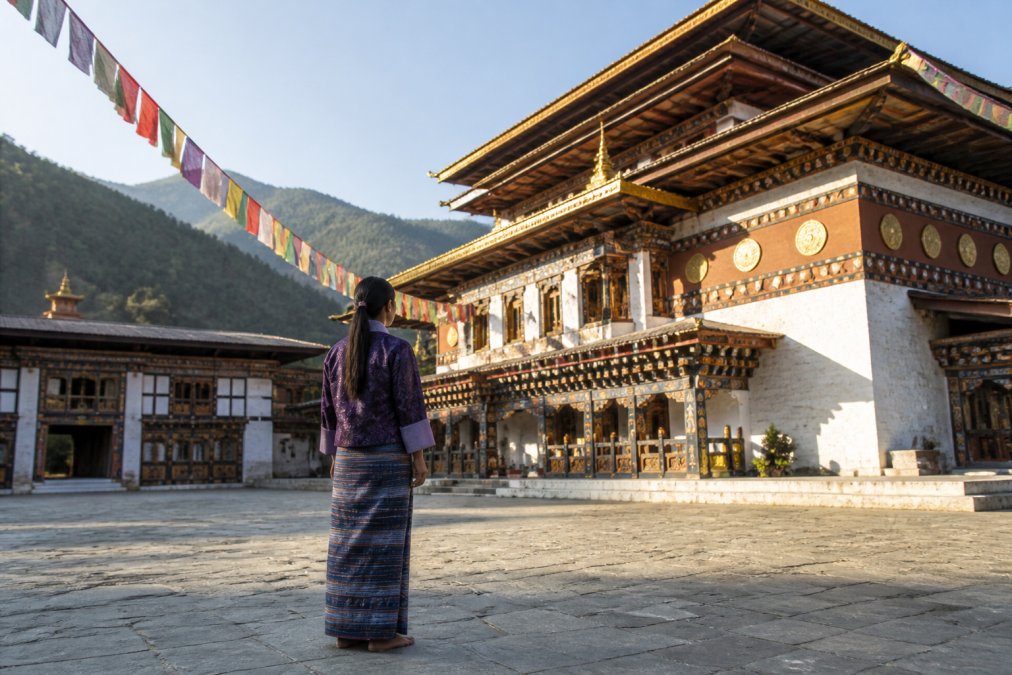
Temples and monasteries are living sacred spaces, not museums. Respect for local customs determines whether you're welcomed or asked to leave.
Photography rules are strict. Never photograph altars, statues, or monks without permission. Many monasteries forbid cameras entirely in certain areas. Always ask before taking any image.
Dress appropriately. Wear long pants or skirts and covered shoulders. Remove shoes before entering prayer halls. Avoid bright colours that distract from spiritual practice.
Movement matters. Walk clockwise around sacred spaces. Never point at religious objects or people. Keep your head level with or below monks' heads, never above them.
Behaviour expectations include silence in prayer halls, no eating or drinking in sacred areas, and no touching religious texts or objects unless invited. Sit respectfully; never point your feet toward altars or statues.
These aren't arbitrary rules. They reflect centuries of Buddhist practice and community values. Following them opens doors. Ignoring them closes them.
Many visitors learn these rules after making mistakes.
Pack Essentials for Bhutanese Monastery Visits and Mindful Practices
Packing for Bhutanese monastery visits requires balancing minimalism with practicality. High altitude and unpredictable weather demand preparation.
For monastery visits:
- Long pants or skirts (2-3 pairs)
- Long-sleeved shirts (3-4)
- Comfortable walking shoes with good grip
- Warm layers (fleece, wool sweater)
- Respectful day bag for carrying offerings or personal items
For mindful practices:
- Meditation cushion or yoga mat (lightweight, foldable)
- Comfortable loose clothing for practice
- Journal for reflection
- Minimal toiletries (monasteries provide basics)
- Any required medications
General essentials:
- Warm jacket and rain gear
- Sunscreen and sunglasses (high altitude sun is intense)
- Reusable water bottle
- Headlamp or small torch
- Earplugs (monastery bells ring early)
Avoid packing:
- Revealing clothing
- Electronic devices beyond one phone
- Excessive makeup or jewellery
- Leather products (not worn in monasteries)
- Alcohol or tobacco
Plan Your Digital Detox and Manage Connectivity
A genuine mindful Bhutan trip requires honest engagement with your digital habits. Constant connectivity undermines the entire purpose of the journey.
Before you travel:
- Set an out-of-office message
- Delegate urgent work
- Inform close contacts of your limited availability
- Consider leaving your laptop at home
During your trip:
- Check email once daily, if necessary
- Avoid social media entirely
- Use your phone for photos, not scrolling
- Keep your device in your bag during meals and practices
Prepare Psychologically for High-Altitude Mindfulness and Post-Trip Integration
High altitude affects your mind as much as your body. Arriving at 2,500+ metres changes how you think and feel. This is normal and manageable with preparation.
Plan for this. In your first week home:
- Maintain your meditation practice
- Limit social media and news
- Spend time in nature
- Journal about your experience
- Avoid major decisions or commitments
Frequently Asked Questions
How many days are enough to plan a meaningful mindful Bhutan trip?
Five to seven days allows you to experience authentic cultural immersion without rushing. This timeframe gives you days for monastery visits, meditation practices, and slow-paced trekking. Shorter trips risk feeling pressured; longer stays (10-14 days) deepen your spiritual journey and community connections. Work with your operator to pace activities around your energy and altitude adjustment.
What is the Sustainable Development Fee and how does it support mindful tourism?
The Sustainable Development Fee (SDF) is a daily tariff all visitors pay, supporting conservation and community projects. It funds local infrastructure, education, and healthcare while limiting overtourism, directly enabling the mindful, low-impact travel experience you seek. The fee ensures your visit benefits Bhutanese communities and preserves the serene environment that makes mindful practice possible. Your operator includes this in all-inclusive pricing.
What should I pack for Bhutanese monastery visits and meditation retreats?
Bring modest clothing that covers shoulders and knees, comfortable walking shoes for uneven terrain, and layers for temperature changes at high altitude. Pack a meditation cushion or yoga mat if you have preferences, plus sunscreen and a water bottle. Avoid loud colours and perfumes. Include a small notebook for reflections and a headlamp for early morning practices. Your operator will provide a detailed packing list tailored to your itinerary.
How can I ensure my Bhutan trip supports local communities and responsible tourism?
Choose a licensed operator committed to community-based tourism and hire local guides and porters directly. Stay in locally owned guesthouses and eat at family-run restaurants. Participate in homestays or village experiences where your fees directly reach families. Respect photography restrictions and sacred spaces. Ask your operator how they invest in local education and conservation. Responsible choices amplify your positive impact while deepening your authentic cultural connection.